Showing posts with label Archery. Show all posts

Friday, October 26, 2018

Deer Society "Mr.Maybe" Video Highlight

As I sit here on a Friday evening listening to the rain pour down on the North Carolina countryside, and thinking about the buck I saw in the front yard this morning, I got an itch to watch some hunting videos.  Yeah yeah "you might be a hunter if (fill in the blank)".  That may be a good idea to try sometime, let me know in the comments if you have a "You might be a hunter if..."!  But seriously, if you can't hunt during deer season, do the next best thing: watch footba, I mean, hunting videos.  So, here's a thought.  I'm going to be posting some video's of hunts/stories with the tactics they use to get the deer, and provide my thoughts.  With my own story of Prince last year, I may do a little video of my own if that appeals to anyone!  I don't have any hunt footage, but I can share pictures and narrate my story!

Normally the video's will be fairly short, though this one is a little more than 10 minutes, but worth the watch to me.  So here's my video highlight pick, a video by Deer Society of a buck called Mr.Maybe :


The tactic of using buck scent, in addition to the water source, is a fantastic setup.  Given the conditions of drought, in combination with the fact he was a dominate buck, just shows how a little ingenuity can tip the odds in your favor.  Being the dominate buck, he would need a challenger to face him for him to even be interested.  But he knew all the bucks in the area.  So by using unfamiliar scent in his core area, it nagged and annoyed the buck.  Which was the bucks undoing, and the arrow that shot him literally had his name on it.

Hope you like this new spin on things.  I plan on bringing out a couple more video's in the future, in addition to telling you about my trip to Montana back in the summer!  Keep hunting!

Friday, October 6, 2017

Predator

No, this is not a movie review of Predator starring Arnold Schwhatshisname.   This is a short story about a recent hunt of mine that ended, well, unexpectedly.

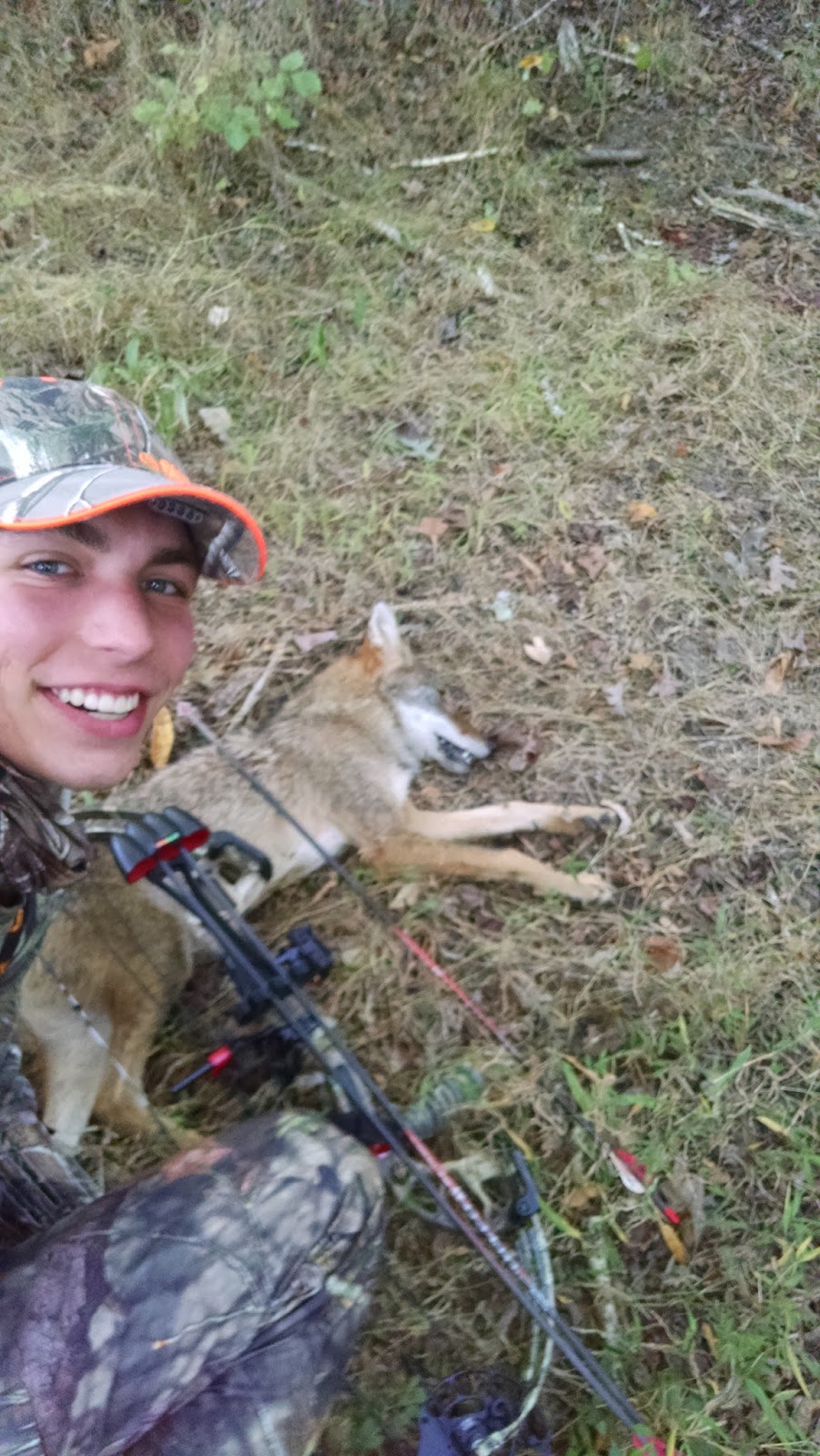
I was in the stand about 4:30ish.  Maybe some people will get on to me and be like "be in the stand earlier!" Don't care.  I've got it down to where I know deer appear around 6 in the early season and 5:15 in the late season.  So I'm there a while before the deer are.  After about an hour and a half, right at 6, I look right and there is a 6 point buck, he just kind of appeared, I never heard him walk up, but ok then.  Not big enough to shoot (maybe half the size of the 8 point I got last year) , I decided to let him pass, a doe came out.  I stood up slowly when the deer weren't looking, but I never got a shot on the doe.  They simply walked off into the woods at my 2 o'clock.  Still standing after about 5 or so minutes, I look to my left into the woods at my 9 o'clock.  I see 4 legs walking through the brush, but I notice it's not a deer...this is a coyote.  Now I beg for him to turn right, towards my stand, so that I could have a shot.  Sure enough, he does.  I wait till his head goes behind a tree to draw, and hold on my anchor point and aim.  The coyote, after coming from behind the tree, is still hidden by briars grown up next to the tree.  I hold the bow back for another 10 or 15 seconds (forgive me for inaccurate time, it seemed like I held the bow forever when it was probably just a few moments), and finally I get a shot.  20 yards, WHAP!  The sound of an arrow hitting its mark.  The coyote did not make it a few feet before it fell, the Muzzy Mx-4 having done it's work.  After giving it a few minutes to expire, I got down from the stand to see my first coyote kill.

Sorry for the blurry selfie


Now to attempt at a deer!  Keep hunting and stay safe! 


Thursday, August 4, 2016

The Season Approaches

It's almost hunting season!  Are you ready?  I know I'm not, as far a prep goes!  BUT, here's a few things to help rev up for the season:

  • Glass fields and crops such as soybeans at dusk.  It's also a great way just to sit out in nature and enjoy it, take someone with you too!
  • Put out trail cameras.  I have a camera out, I need to check it :) I've been away lately, but I can't wait to see what it has captured in pictures!  As far as trail cameras go, look for patters in activity.  If you have consistent pictures of deer at 8am and 5pm during the summer, then during the early season they should still be following that same pattern.  Thus, you know when you should be in your stand.
  • Shoot!  Shoot your rifle, shotgun, your bow.  Sight in the scope.  Pattern your shotgun and perfect that lead by shooting some skeet.  While shooting your bow; perfect your anchor point and release, not to mention arrow grouping.
Enjoy your prep time!  Can't wait for fall!

Wednesday, October 21, 2015

Know Your Distance

Hello all!  A couple weeks ago I was out hunting in the evening.  I was set up close to where I had seen deer feed under some oaks.  Around 6 p.m. , a buck came up towards me.  After waiting a few minutes to make sure he wouldn't see my movements, I pulled back my bow for a shot and settled the 20 yard pin right behind his shoulder.  The distance from me to the buck was longer than I thought, because the shot went right under his belly.  He came back, and gave me another shot.  I misjudged again...twice...but I got very close on the thirty yard shot.  Anyway, the point of the story is: know how to estimate yardages correctly. Now I know where to aim when I go back to that spot, I just wish I would have the first time.

How do you learn to estimate yardages correctly?  Practice at varying ranges.  Get good at it.  If you have a life size deer (elk, bear, coyote) target, all the better, because you can see what that animal looks like at 17, 24, 32 etc. yards.  When you see that in the wild and remember what it looked like in target practice it helps a lot.  For example, I see a deer come out in front of me, and it looks about as big as the target I have at home when I shoot from 28 yards, I aim for 28.

Thursday, August 7, 2014

Prep For Hunting Season

Hunting season is just around the corner!  While summer is a great time to fish and swim in pools, it's also a great time to get outdoors in the woods and prepare.  Here's a list of things that you can do to prep for the final weeks till the season:

  • Backyard bow practice!  Start drilling on your form, aim, release, and follow-through.  Backyard bowhunts are another fun thing.  You put out a target (a 3D makes it a WHOLE lot funner!) and you start from one side of your yard, and creep up on the target, and make a shot.  You practice your skills for a stalk or still hunt.  You can also do this on a treestand.  Go up, sit like normal, then act like the target you set up, say, a deer, walks into view.  Slowly stand up and draw, aim, release, and follow-through.
  • Scout!  Look for tracks, trails, browsed plants.  Food sources, bedding areas, you name it!  If you can locate a trail that is close to bedding and food sources for around the year, your set!  For example, one place that I'm looking at putting a stand is close to a trail that passes oaks, a greenbriar patch (which deer like to eat), and bedding.  And when it rains, a small ditch actually makes a temporary pond.  Perfect spot for a stand! Which leads me to my next point...
  • Hang Stands!  Looks for spots like what I mentioned above.  Not only that, but bedding near creeks, trails, food sources, near corn fields, and so on.  
  • Sight in your gun!  If you don't sight in your rifle, you won't hit anything.  Not only that, but practice with it, let it become almost a part of you since your so good at handling it.
  • Put out trail cams!  (I'm repeating myself) Near trails, bedding, food sources, mineral licks, so on.
Other things that I'll leave out of the "big" list is establishing mineral licks and food plots.  Now, food plots are meant to complement natural food sources, not replace them.  You might could just seed a place with naturally occurring seeds, or let the plants come up by themselves.  Sometime food plots can be a pear tree, or an oak stand.  They don't have to be a lawn of clover.  And they are not necessarily necessary to have a great hunt!  I just do a little bit of it because I enjoy doing it.

Stay safe, get your licence, and get ready to hunt!  Until next time!

Friday, January 31, 2014

Be Resourceful

I have a Delta River Bottom Intruder 3-D target.  I tried it, and it didn't work with broadheads like it was supposed too.  It actually destroyed them.  So, after some thought,  I think I'll try to make this target into some kind of decoy.  Put some scent on it, and put it close to a stand somewhere and see what happens.  So, if some product doesn't work well, find what it can do.

And for future targets, I think I'm going to go with Big Green or Hurricane.

Monday, November 4, 2013

Product Review- Hurricane Bag Target

I think that the Hurricane Bag Targets are awesome.  Sure, you can't put broadheads into them, but they provide great target practice.

Durable
The bag target sustained 100's of shots from my bow, over a few seasons.  Eventually I was careless and left it outside most of the time, and if I kept it in a dryer place, it would have lasted even longer.

Nice Aiming Points
I have a target that has a deer vital area shown on one side, and "hurricane" looking aiming points on the other side.  I used the deer vital side much more than the other side, because it gave me a realistic thing to shoot at.

I Could Move It Around
All I needed to do was to pick up the strap and go!  Now, I wouldn't say that anyone could do it, depending on strength and age.

I like Hurricane Bag Targets.  I would recommend them.

Friday, October 18, 2013

Select A Bow

For those who want to get a bow, you must ask, "What type of bow do I want?"  You can boil it down into two main categories: traditional and modern bows.
  I would suggest that you look at if you want a modern compound or a traditional recurve bow, for example. Compounds give you let-off at full draw, while traditional bows do not.  Check out these two articles that I have written in the past to help you narrow down your choices:


  Another thing to consider is to see if you are right or left handed.  You need to find a bow to fit that need, obviously.  Some bows can be right or left handed, but not many.  Here is an interesting fact I found from "Archery Bows and Arrows Online," "However, reality is if you are right handed you will be holding your right handed bow with your left hand so be sure, if you are shopping on your own, to pick the one that you hold in the opposite hand of your dominant hand.1"  Great tip.
  An archery pro shop would really be of use in helping you find your draw length and weight.  They can measure how far you need to draw back the bow to get it to full draw, and how much weight you can pull back, because it won't work if you cannot.
  I have read that you can measure your arm length to figure out what draw length you need, but, as I said, archery pro shops really help.

Happy hunting!


Tuesday, November 27, 2012

Why Wax a Bowstring?

Bow wax is a great thing to have to help lengthen the life of your bowstring.  Why?

Why wax it?

  • Wax is used to help lubricate the string to reduce friction. 
  • It shields your string from dirt, rain, and other objects. 
  • Keeps your string from fraying.
  • Helps your string have a longer life.


What if I don't wax it?

  • Your bowstring could become "infected" with dirt and moisture, which will sooner or later destroy your bowstring.  To make it worse, moisture also slows down arrow speed.
  • Without lubrication, the strings will fray and wear down, the string will also produce friction, and these three things will drastically shorten the life of your bowstring.
In short, waxing gives a longer life to your bowstring.


How do I wax it?

Apply wax to your bowstring and rub between your thumb and your index finger or middle finger over a 4-5 inch section of string.  When you feel your fingers get warm the wax should have melted into the string and is lubricating it.  Then move on to the next section. 

Tuesday, November 20, 2012

What a Bow Peep Sight is For

What is a peep sight for?  Why do some models have a tube on them?  These are questions I hope to answer in this article.

1.What is a peep sight for?  Do I need one?
A peep sight acts like a rear sight of a bow.  If you can't see through it, you should know that your stance is wrong.  It makes sure that you come back to the same anchor point every time you draw the bow.  So, you don't need a peep sight, but it would be pretty good to have one.

2.What is the tubing attached to the peep sight on some models?
The tubing is to keep the peep sight from moving or twisting while it's in the string.  So, it is pretty much there on some models for an unstable string that could cause the peep sight to get out of alignment.


Saturday, July 28, 2012

Compound vs. Recurve

Okay, time for round three.  You can read all the pros and cons of both bows because I have posted about both.  It is now time to see who is the winner!

The Winner!!

No one.  IT'S A TIE!!!!  I am just saying that for myself, because they are both good bows.  But you can decide for yourself who you want to win.

Compound vs. Crossbow

Here are the more high tech bows about to face off in Round 2 Compound vs. Crossbow!

Compound


Pros and Cons:


Pros:

  • Quiet.
  • Has a lot of energy coming from the bow into the arrow because of the long power stroke.
  • Lightweight.
  • Accurate.
  • At full draw the pulleys at the end of the bow turn and give you let-off to make it easier to hold at full draw.
  • It isn't quite as traditional or original as the Recurve or Longbow, but it is a little bit original, after all, it is a bow.
Cons:

  • Because it is lightweight, slight movement can cause the arrow to be a little left or right of the target.


Crossbow

Pros and Cons:

Pros:
  • It can remain at full draw for a long period of time while hunting.
  • You can mount a scope or a red dot sight to it.
  • Some crossbow models have an automatic cocking mechanism.
Cons:
  • The shorter crossbow arrows and the short power stroke of the crossbow can't match the energy stored in the compound bows longer arrows because of the compounds longer power stroke.  The crossbows have to have a higher poundage to make up for this.
  • Crossbows are hard to pull back or crank back.
  • The higher poundage also is hard on the strings and cables and other components.
  • Heavy.

Compound wins!  No offence crossbow, I would still like to shoot an arrow from you sometime.  People who make crossbows are still trying to make their crossbows lighter and more efficient.
Round 3 is next with the final contestants:  Compound vs. Recurve! 

Wednesday, July 25, 2012

Longbow vs. Recurve


I will be doing a bow tournament in my next couple articles to determine what is the ultimate bow (though all are good, don't take me wrong). I won't be judging anything to win just because I want it to, I will pick the winner the same way I would pick out what bow I want on a normal day (looking at pros and cons and things like that). Today, read Round 1 Longbow vs. Recurve!

Longbow


Pros and cons:


Pros:

  • It will forgive minor mistakes made by the person that is handling it.
  • Its quiet.
  • Lightweight.
Cons:
  • Its length makes it harder to carry it around in brush.
  • Hard to pull back and harder to keep at anchor point because of there being no let-off like a compound bow.

Recurve Bow


Pros:
  • It can store more energy in its limbs.
  • Its a little lighter than the longbow.
  • They are smaller than the longbow which makes them easier to carry places.
Cons:
  • Hard to pull back and has no let-off.


Recurve Wins!

Both of these bows are traditional and original (in some ways).  Someday I even would like to shoot both of them.  Next time the more technical bows face off!  Don't miss Round 2 Compound vs. Crossbow!  Whichever bow wins Round 2 goes against  the Recuve Bow in Round 3!


Tuesday, June 19, 2012

Selecting a Broadhead

For those who are just beginning bow hunting, broadhead arrowheads are used to kill deer.  That information may not have been necessary but its good to know.  I am going to talk about the two most popular broadhead types, fixed and mechanical (or expandable).

Fixed Broadheads
Fixed broadheads are the most used broadheads the world has ever known.  Even the Indians used fixed broadheads, though they didn't call them that.  Here are the pros and cons of a fixed broadhead.

Pros

  • They are sturdy
  • Cut on impact
  • Don't need a high poundage bow to ensure penetration
  • Definite cut
  • Blades are usually replaceable
Cons

  • Could cause personal injury while putting on the blades and attaching it to the arrow
  • Smaller cutting area than a mechanical broadhead    
                                                                                         
Mechanical Broadheads
These broadheads have little tips on them that help the blades to expand on impact.  The blades are usually held together by O-rings, elastics or bands of some type.  Since the blades are in the arrowhead this type of broadhead flies like a field point until impact.

Pros
  • Flies like field points would
  • Less chance of injury since blades are in the arrowhead
  • A bigger cutting area than fixed broadheads 
Cons
  • Risk or mechanical failure
  • Needs a faster arrow speed to open up the blades on impact, which leads to needing a higher poundage on you bow
  • Doesn't cut until the blades are open

I plan to stick with fixed broadheads.  But you decide what you want to use.       


Friday, February 3, 2012

Arrow Care

Arrows are one of the most important parts of the bow.  But they need care.  When you go out to soot here are some types common damages to each arrow to look for:

Wooden arrows
  • Look for splinters and small cracks
Aluminum arrows
  • Look for creases, dents, and cracks
Carbon arrows
  • Look for the same thing as aluminum arrows.
Remember to never shoot a cracked arrow, no matter where the crack is.  If you shoot an arrow with a cracked shaft, it could shatter.

Keep arrows in a quiver put some place safe or in a bowcase that has a quiver installed in it. 

Thursday, December 29, 2011

How To Sight In Your Bow

If you have a compound bow and you want to sight in your sights (if you have any) then here is what you do.
First shoot a group of three or four arrows at the bulls-eye of the target.  Wherever the  arrows go that is where you move you sights.  For example, your arrows go left and above the bulls-eye.  Move your sights up and left. This is called "follow the arrow."  It rhymes doesn't it!  Sight your sights wherever your arrows go till they hit the bulls-eye consistently.  Pretty simple huh!