Showing posts with label Techniques. Show all posts

Friday, October 26, 2018

Deer Society "Mr.Maybe" Video Highlight

As I sit here on a Friday evening listening to the rain pour down on the North Carolina countryside, and thinking about the buck I saw in the front yard this morning, I got an itch to watch some hunting videos.  Yeah yeah "you might be a hunter if (fill in the blank)".  That may be a good idea to try sometime, let me know in the comments if you have a "You might be a hunter if..."!  But seriously, if you can't hunt during deer season, do the next best thing: watch footba, I mean, hunting videos.  So, here's a thought.  I'm going to be posting some video's of hunts/stories with the tactics they use to get the deer, and provide my thoughts.  With my own story of Prince last year, I may do a little video of my own if that appeals to anyone!  I don't have any hunt footage, but I can share pictures and narrate my story!

Normally the video's will be fairly short, though this one is a little more than 10 minutes, but worth the watch to me.  So here's my video highlight pick, a video by Deer Society of a buck called Mr.Maybe :


The tactic of using buck scent, in addition to the water source, is a fantastic setup.  Given the conditions of drought, in combination with the fact he was a dominate buck, just shows how a little ingenuity can tip the odds in your favor.  Being the dominate buck, he would need a challenger to face him for him to even be interested.  But he knew all the bucks in the area.  So by using unfamiliar scent in his core area, it nagged and annoyed the buck.  Which was the bucks undoing, and the arrow that shot him literally had his name on it.

Hope you like this new spin on things.  I plan on bringing out a couple more video's in the future, in addition to telling you about my trip to Montana back in the summer!  Keep hunting!

Wednesday, June 13, 2018

Fishing Shallow Rivers


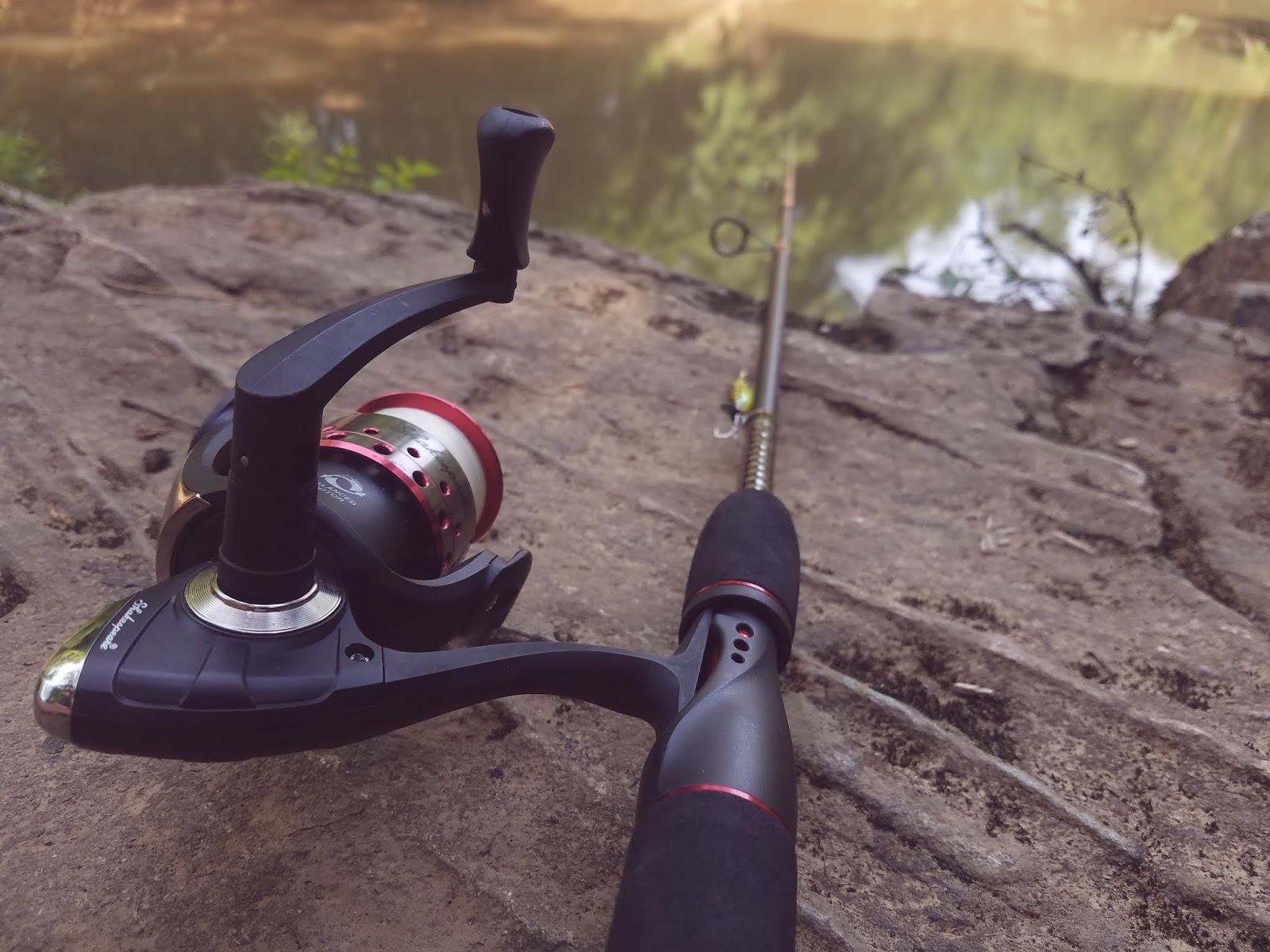
Recently I've started fishing the local Haw River at different spots and the adjoining creeks, such as the Great Alamance Creek.  And when I went looking for tips on shallow water fishing, and even specifically the Haw, I came up with little.  So I've been exploring and fishing and experimenting different spots along the river, trying to learn about this local resource. While fishing in rivers is still new to me and I have plenty of room to perfect my performance, here are some of the things I have noticed that may come in handy for those who fish the Haw.  And it's likely that some of the things here apply to other small/shallow water bodies as well.

Fish the pools, not the main current
While trout may enjoy the main current of a stream or river, many fish simply do not.  Target calmer areas of the water made by rocks or sandbars.  Those calm pools and eddy's will generally house more fish.  This is especially true when the faster moving water, as is the case with the Haw, is particularly shallow and does not allow bigger fish to swim in those areas.

Try smaller lures
When fishing the shallower water, a surface lure can do the trick.  I like to use a Heddon Teeny Torpedo and I catch decent brim.  The smaller fish are especially fun on light tackle.
Another lure I like to use is a minnow with a spinner blade, such as Mepps Comet.  This will especially attract the smaller fish, such as brim or pumpkinseed.
One thing I would tell you?  Give fly fishing a try on smaller rivers, it's a blast.

Different spots for different fish
May sound a little obvious but hear me out.  Depending on what you want to catch, how much you want to catch, or in some cases WHO you bring with you (such as little ones) you need to try different spots to suit your desires or audience.  Smaller pools generally house the brim, which are fun for fishing newcomers and kids especially.  Those fish are fun, don't discount them.  AND, it provides an experience different than a cliche lake or pond to take new fisherman to (not saying in any way lakes or ponds is bad, they're a blast, it's just different than the norm).
If there are islands in the river, try the downstream side where there is generally a much bigger area of calm water.  That is where you will find fish such as bass or catfish.
If there is a slower moving creek (or if the river splits) with features such as big rocks or logs, try in those areas because bass be in the slower moving water and cover.

Caught this Pumpkinseed on a minnow jig

Sunday, November 19, 2017

A Prince of the Forest, Part 1

There are bucks that have pep and are fun to watch, but are too small to shoot.  There are good bucks that you see, but not shoot.  There are bucks that love a certain area, a certain time of day, have unique antlers, all sorts of things can set a buck apart.  This buck, he liked a certain time of day and had unique antlers.  A nice bodied 8 point with a curved main beam, long G2s and 3s, and loved the night.  His name is Prince, named after Bambi's father, the Great Prince of the Forest.  I thought it fit, whether or not it was an original name.  Here are some pics of him:


Sorry for the blurry pic!


Pic from my new Wildgame Innovations Mirage 14

I had a problem.  As you can see, all these pics were taken at night, and not just that, but well before (or after) shooting light.  The earliest he ever came out is 6:50 pm, just 20 minutes after I had left my stand that evening.  The latest in the morning?  5:55 am, too early to shoot.  He wasn't coming out when and where I want him to.  So I had to figure out where he was in the daytime, which can be a challenge if you don't exactly know where to start.  So, I set another camera out in the woods to hopefully catch him in the day time, meanwhile, my other camera kept getting pics of him at night.  

With the whitetail rut coming up I knew and heard the best time to get him would be the next three weeks or so (about mid to late November).  I knew a doe group was in the area, not to mention all the other does that liked to hang out by themselves, so I would have plenty of chances to see rut action.  All I could do at this point was be where does were and patiently wait for him to show.  

Wednesday, October 26, 2016

Sensed, Avoided, Busted

Hunting season is in full swing now, and it's nearing the end of October, and in many places, not far from the whitetail rut.  I still haven't tagged a deer.  I've seen plenty, but they simply haven't come into range.  But I think I figured out the problem.
Every time a deer enters the field to the right of my stand, they feed for a while and when they get about 40-50 yards from the stand, they stop and lift up their heads and sniff.  They know something is there.  It's quite fascinating actually.  It's as if there is a circle drawn in a 40 yard radius from my stand.  No matter where the deer enter the field, they don't act like anything is wrong until WHAM!  They hit an imaginary wall just outside of my bow range and they know something is there.  Every. Single. Time.  I had 2 bucks, one a nice 6 point, do it.  I had a group of 4 does do it.  I've had numerous other deer do the same thing: 40 yards, stop, lift up nose, sniff, walk the other way.  They don't see me, they don't hear me.
They smell me.  I believe you can be as quiet and as hidden as you want, but if deer smell you, they will bust you every time.  The oddest thing is, I believe I'm controlling my scent.  Last year all I did was rub fresh pine needles against my clothing and gear and it worked, I harvested 3 deer, I don't think any knew I was there, not to mention all the other deer I encountered that season. This year is different.  I have some scent killer spray, maybe I should use instead.  I know I should pay more attention to the wind, but I can be careless because I want to hunt every chance I get.  I'll see how it pays off.  Hopefully with good results.

Monday, June 13, 2016

Fishing with Artificials

Recently, I've had the privilege of fishing at a friends pond.  I've only used artificial lures while there.  And while pond fish may not react the same to lures as lake fish, I've noticed a couple things:

  • Big sunfish and any size bass will attack minnow spinners.  I use a Strike King Pro Series 2" minnow with spinner blades.  This little minnow spinner has worked magic on those fish.  I had sunfish and bass hammering the lure.  The bass weren't monsters, in fact, they weren't even big, but on my ultralight, they gave a fun fight.
  • I noticed that the bass like to hang out near a tree line with a drop off.  That way they can get to cool water quick, have access to food that falls from the tree, and be in the shade at the same time.  Perfect place to fish!
  • If you find a bed of sunfish, cast a jig out past them, and reel in the jig, letting it fall to the bottom before making it rise.  Or, reeling in slowly and steadily while twitching the lure may work as well.  
Here are some of the fish I caught on the minnow:
Nice size bluegill

Small Largemouth

I don't know what fish this is...bluegill with spots?

Before I close, I would like to mention that I now have a Cabela's Wind River fly reel.  It works great, and it's nice and shiny!  Keep fishing and prep for hunting!

Saturday, October 4, 2014

Mid-Season Sucess

How is the deer season going?  I have yet to take a deer, but I've only been out 4-5 times, twice I didn't see anything (well, except a doe and fawn 150 yards off), twice I've seen deer, and ultimately both times they spooked.  And lastly on a hunt I saw a coyote while hunting on the ground, I didn't stay to see if there were more.  But I'll give you a few tips and try to follow my own advice here:

  • Try calling.  Doe grunts may work, and fawn bleats might still do the trick.  
  • Have a strategy.  Know when, where, and how your going to hunt a particular area.  Let someone know where you are, just for safety.  
  • Hunt food sources.  Acorns are now starting to fall, so head over to some oaks.  Food plots may also be productive.  
  • Any hunt you can walk away from is a good hunt, so stay safe.
Have a good weekend!

Monday, August 25, 2014

Pinpoint Hunting Spots

In prep for hunting season, make sure you know where to hunt on the property (or properties).  Many hunters look at a good looking spot, hoping deer are in the area.  Sometimes they get lucky, other times, not quite so much.  I don't want anyone to be like that.  So, here is a list of places that would be good spots:

  • Look for trails leading from bedding to feeding areas.  Trails leading to oak trees would be dynamite spots when the acorns fall.
  • Funnels.  Look for places that narrow deer movement to a small area.  An example would be a thin strip of woods in bordered by fields on both sides.  Or, there might be a field on one side and a river on the other, with a little bit of woods in between.  
  • In public land, look for places other hunters don't go!  Many hunters on public land (or even private) may not go that far from their trucks to their hunting spots.  Go twice as far as they do.  Also look for places that hunters look over.  Those places will probably hold deer since they are unpressured in that area.
In all, look for food sources and unpressured areas.  Does will go there, and bucks will follow.

Get your license and hang up stands!  It's just around the corner!  'Till next time!    

Thursday, August 7, 2014

Prep For Hunting Season

Hunting season is just around the corner!  While summer is a great time to fish and swim in pools, it's also a great time to get outdoors in the woods and prepare.  Here's a list of things that you can do to prep for the final weeks till the season:

  • Backyard bow practice!  Start drilling on your form, aim, release, and follow-through.  Backyard bowhunts are another fun thing.  You put out a target (a 3D makes it a WHOLE lot funner!) and you start from one side of your yard, and creep up on the target, and make a shot.  You practice your skills for a stalk or still hunt.  You can also do this on a treestand.  Go up, sit like normal, then act like the target you set up, say, a deer, walks into view.  Slowly stand up and draw, aim, release, and follow-through.
  • Scout!  Look for tracks, trails, browsed plants.  Food sources, bedding areas, you name it!  If you can locate a trail that is close to bedding and food sources for around the year, your set!  For example, one place that I'm looking at putting a stand is close to a trail that passes oaks, a greenbriar patch (which deer like to eat), and bedding.  And when it rains, a small ditch actually makes a temporary pond.  Perfect spot for a stand! Which leads me to my next point...
  • Hang Stands!  Looks for spots like what I mentioned above.  Not only that, but bedding near creeks, trails, food sources, near corn fields, and so on.  
  • Sight in your gun!  If you don't sight in your rifle, you won't hit anything.  Not only that, but practice with it, let it become almost a part of you since your so good at handling it.
  • Put out trail cams!  (I'm repeating myself) Near trails, bedding, food sources, mineral licks, so on.
Other things that I'll leave out of the "big" list is establishing mineral licks and food plots.  Now, food plots are meant to complement natural food sources, not replace them.  You might could just seed a place with naturally occurring seeds, or let the plants come up by themselves.  Sometime food plots can be a pear tree, or an oak stand.  They don't have to be a lawn of clover.  And they are not necessarily necessary to have a great hunt!  I just do a little bit of it because I enjoy doing it.

Stay safe, get your licence, and get ready to hunt!  Until next time!

Tuesday, August 5, 2014

Fishing on the Watauga River

The Watauga River in western NC is only 60 miles long, but it offers good fishing, depending on where you fish.  Watauga is a Cherokee name and it means "the land beyond 1."
  Last week I was in the mountains with family and we wanted to throw in a line.  A man pointed us to a road that runs parallel to the river.  We went and fished, and caught nothing for a while.  Then, I had almost given up, and BAM!  A smallmouth hit my lure with a fierce blow.  I fought him a little too quick, because he had a lot of fight in him.  I was just about to grab him (he was around a foot long and weighed maybe 2lbs, at least 1 1/2lbs) for a picture and the jerked and flipped and snapped the line!!
  Even so, I had fun. I'll try to get some pictures if I can, then I'll add it to this article.  But here are a few things I have learned about river/creek fishing in general:

  1. Fish what the fish will bite.  If they don't want surface lure, try a diver (where legal) or a spoon or worm.  Jigs will also trigger a bite.  If the river is shallow, get a diver that, of course, dives but floats. If it sinks, then it will drag along the bottom like a rock when you reel it in.
  2. Artifical bait is good for using a small bobber and a little line below it.  Don't go any deeper than about 8 inches, but that will depend.  A shallow creek will need less line below the bobber than one would in the Mississippi River.
  3. Bass strike hard and fast.  They (at least smallmouths) also like to jump out of the water.  Keep you line tight and try to tire the fish out a little by giving him a little line.  But keep it tight.
  4. Trout seem to know if someone is fishing for them.  You have to be somewhat stealthy and don't let them know you are there.  
As anyone should, check your state fishing laws to make sure the way you fish is legal.  And always have fun.  Till next time!!

1. http://en.wikipedia.org/wiki/Watauga_River  

Thursday, December 20, 2012

December Rut


I have two main things to say about hunting in December, hunt does to find the bucks.  And, hunt food plots, because deer need the food to help them stay alive during the winter.  This also ties into hunting does to find bucks.  The does who are in estrus will go to a food plot, which attracts bucks to that food plot.  But the bucks also need food, so they will be there anyway, which they will be looking for does in estrus still.  All of this sort of works out together and ties into each other.

What is the Secondary/December Rut?
Every hunter knows what the rut is, it is when the peak mating happens, when bucks go crazy.  Many hunters put all their hunting money into this 1 or 2 week long period and forget about the rest of the season.  I know that adults have to take off or hunt on weekends, so I be a little easier on them.  But many, as I said, might hunt a little before, during, and a little after the rut.  Then they forget about it, it's over.
But the secondary rut is right around the corner!  Not all does get bred in the November rut, so some does come into heat a second time around the middle of December.  Now, there won't be quite as much action as the fist rut, because there are less deer around.

Tactics

  • Hunt food plots and areas with a lot of deer activity.
  • Use tools, deer calls, scents, and other things that you would use during the first rut (why not, its the second one, so use the same stuff).

So, in brief, the Secondary (or December) rut happens in mid December.  Use calls, scents, etc.  Hunt around food plots and any area that has a lot of deer activity going around.  Hunt does to find bucks.  
Lastly, have a great rest of the hunting season and year. 

Wednesday, December 5, 2012

Multi-Species Hunting

There are a couple places that you can hunt multiple game species in one area.  Pretty cool huh?

Orchards
In an apple and/or persimmon orchard you can find deer and squirrel.  Crows and squirrels will also check out cherry orchards.


Food plots or other fields
In winter, if clovers are still around in a food plot, both rabbits and deer will come to those.  Wheat- if an area in a wheat field has been cut, doves will come and if there is still wheat standing, deer will also feed on wheat.  Corn- deer and squirrels will come and eat corn, but squirrels will most likely be around the edges of the fields.  Turkeys will also feed in some food plots.


Forests
During the acorn season, deer, and squirrels will definitely be in the oak stands, and turkeys might also join them in the search for acorns.  Squirrels and deer will also feed on beech nuts and squirrels will eat hickory nuts.  Deer also might eat hickory nuts.

Thursday, September 13, 2012

Unusual Ways to Hunt Squirrels

Now you have probably heard about hunting squirrels by sitting under an oak tree or hickory tree and waiting for the squirrels to come out to feed under the tree your sitting on.  That's a good strategy, but here are some pretty unusual strategies.

Stalking
When you spot a squirrel (probably from a good distances) you slowly walk up close to it and get a shot at it.  Don't walk when it looks in your direction or it will probably see you.  Keep an eye for other squirrels that could be around you that could alert other squirrels of your presence.  If you happen to get a closer shot at another squirrel while your following the squirrel you spotted, you can decide to take the shot at the squirrel closer to you or risk being spotted as you try to follow the other squirrel to get a shot at it.

Stand Hunting
This speaks for itself.  You get in a stand and hunt squirrels from there.

Blind Hunting
Now you are on the ground under some hickory or oak trees in a blind waiting for squirrels to come by.  If it's deer season and you have seen deer activity in that area you may even want to bring a deer rifle with you.

Tips

  • You can also use a small caliber rifle (.177 cal or .22) is also good for hunting squirrels.  You can shoot at a greater range.
  • Wear good camo and something that's blaze orange.
That's all for now!

Saturday, August 25, 2012

Acorns, the Big Buck Attractor

I have talked about the importance of acorns in hunting before, and now I'll do it again.

In the rut bucks are more interested in does than they are in food.  So if bucks are more interested in does, why would they want to go to oak trees?  You can pretty much answer the question with common sense.  The does need the nutrition that the acorns have in them so they can breed.  So if you have a concentration of white oaks which have their acorns are falling, you will probably find does there.  Where you find a bunch of does, you will find bucks coming in after them.

When the acorn crop drops to very low amounts of acorns falling, here's what to do.  Look for an area that has a bunch of oaks beside each other that are producing more acorns than the rest of the oaks around.  Deer should flock to that area because of the higher acorn crop.

Hunt over acorns.  A bunch of white oaks next to each other to hunt over is a good way to get a deer this season.

Friday, January 20, 2012

Cottontail Hunting

To go cottontail (more known as rabbit) hunting a you really need is a field that rabbits would be in.  But how do you find them and how do you hunt them?

How to find them
A good place to look is a place that provides cover for them close to where they get their food, such as clover, alfalfa, wheat, garden crops, grasses, and twigs and bark of small saplings.  Some of their favorite places to hide are at blackberry patches and honeysuckle. 

What to wear and how to hunt them
Now what do you wear when rabbit hunting?  Its easy, a blaze orange hat, vest, something blaze orange so if there are other hunters with you because you are in thick brush and if your alone just wear some anyway because if a hunter happens to come by he'll see the blaze orange.  Always wear blaze orange.  Why?  Your in thick weeds and grasses and you don't want to be mistaken for a rabbit in tall grass!  Wear thick pants also because you will likely run into briar's.
How to hunt them.  If you have beagles, then this article is over for you.  If you don't keep reading.  If your without beagles you can still hunt rabbits by walking them up.  How you do it is you walk for 10-15 paces and stop for 30-45 seconds.  Rabbits are nervous and will think they have been spotted and will make a run for it.  If you have two or more hunters, walk 25-50 feet apart depending on how wide the field is.  Do the same thing with walking them up, though you may want to do it staggered way.  One hunter does his thing, stops. The next does his steps, stops, and so on.  And when you find a rabbit snap shoot him.  You might want to learn this shooting technique.  Good hunting!

Thursday, January 12, 2012

Squirrel Hunting Tips and Tricks

Squirrels are some things to hunt aren't they?  Small little buggers that are hard to aim at.  But these tips and tricks should help you to have success in your next squirrel hunt.  Two hunting strategies are usually used for squirrel hunting, stalking and still hunting (see my article about Hunting Techniques to hear more about these two types of hunting).  This has worked for me, just going out in the morning or afternoon just walking quietly and I usually see a squirrel.

Tips and Tricks
Now that we have discussed on what techniques to use we will discuss about what tricks to use.
  • If two hunters are squirrel hunting then you can use numbers to you advantage.  A squirrel will most likely go to the opposite side of the tree a hunter is looking at.  So getting another hunter to go around and bang on the tree with a stick will make the squirrel go to the other side of the tree, the hunter on the other side can then get a shot.
  • If a squirrel goes into a tree wait a while because after a while with no noise (so you should be quiet) it will come out.  Another way is to hit a stick against the tree and the squirrel will think you are chopping it down.
  • Be patient and perservere.  This hunting requires that.  So don't go crazy if you miss one or lost track or sight of it.  My grandpa used to use this technique when he was a boy when he went squirrel hunting.  You go to an area that has squirrels and if they were all scared away into their nests then sit at the base of a tree and wait.  Sometimes he even fell asleep waiting!  But when he woke up...  The squirrels were out and he could get a shot.


Just remember, wait, be patient.  Squirrels, when they get a high enough population, they can be a trouble to farmers and their crops, so hunting them to keep the population down (but not to far) is not a bad idea at all.

Friday, December 2, 2011

Putting Decoys and Calls together

Decoys and calls are very good for attracting game animals to come to you.  The use of these two things combined is very effective.  The decoys "show" that that type of animal that your trying to call is there, and the calls give effect to the decoys to make it seem like the animals are calling to each other.  The decoys and calls you use depends on the type of animal that you are hunting.  But with these two things being used at the same time the animal sees the decoy and hears the calling and heads toward it.  Then you get your shot.  For deer, you could use some inflatable, 3D, etc.  I think that 3D is best, and the use of a buck grunt call is good for that.  But if you have 2 buck decoys you could put them to close together to were there antlers are touching and use the rattling call.  For geese, you would (of course) use geese decoys and calls.  All in all, use the decoys and calls that are appropriate for the type of hunting you will be doing.

Tuesday, November 29, 2011

Hunting Techniques

Hunting is my favorite sport.  It is fun to track down, find, and call to the game you after is very cool.  This will cover the 6 basic types of hunting .

 There are 6 main types of hunting that basically every type of hunting will fit into.  Still hunting, stalking, flushing, posting, ground blinds, and elevated stands, these will be described in further detail later.  For deer hunting in Snow Camp in central North Carolina, you would usually use the last three techniques.  For squirrel hunting, you could use still hunting, stalking, and posting.  For rabbit hunting, you would probably use flushing.  Every animal you hunt you will have to most likely use one of the six types of hunting to properly hunt the animal your after.

Still Hunting
Still hunting, as it is name implies, involves being still and listening most of the time.  You need to be stealthy while walking in that animals territory.  Stop frequently to scan and listen for game.  You should be still 10 times as much as walking or moving.  Keep low, because the figure of a human will frighten most animals.  Keep some binoculars with  you to scan for game in open terrain to spot movement of game.  When you hunt this way effectively, animals won't know your there, that's good!  But hunters won't know your there either, that's bad.  So always wear fluorescent orange.

Stalking
When stalking, you follow the game your after by using signs that lead to that animal or animals.  Or close the distance to the animal already spotted.  You can follow tracks and if in the morning, a "dew" trail trough brush or leaves.  Or you can follow the sounds of the animal.  Or you could get closer to an animal for a better shot.  This type of hunting requires you to stay very focused on what you are doing, you have to stay downwind, stay silent, stay alert, and stay patient.

Flushing 
This type of hunting requires making noise, movement, or dogs to cause game to becomes nervous and run or fly from cover.  Pause often while trying to flush game.  Varying your pace will make the animals think that they have been detected and more likely to leave cover.

Posting
This involves sitting or standing in one spot.  The place could offer a vantage point or along the animal's trails.
This type of hunting is effective when you know where the animal's travel every day and where a blind or tree stand isn't available.  A good posting site is a place where you can swing your firearm freely or draw your bow back.


Ground Blinds
These are makeshift or temporary ground structures that offer concealment for the hunter.  You should put them: downwind based on wind patterns at a certain time of day, away from the sun, and where foreground and background are safest.

Elevated Stands
Elevated stands (elevated blinds or tree stands) conceal and put the hunter above the game animals the hunter is after.  Elevated blinds of tower stands are usually big boxes that conceal the hunter above ground level.  Tree stands  are stands that are placed against or on trees.  In these always wear a full body harness to catch you if you are to fall.